Wake Up, Rohingya
Bismillahir Rahmanir Rahim.
Dear Rohingya brothers, sisters, and elders, have you ever stopped to think about how we reached this point? How did we end up with no home, no recognized identity, no country to call our own, limited access to education, no secure means of survival, no dignity, and instead face rejection and hardship from many around us, both across the region and beyond?
There comes a time when every community must stop, look back, and ask itself one question.
How did we get here?
For the Rohingya people, that question matters more than ever. If we do not understand how we reached this point, we cannot know and understand how to move forward.
Many people think the tragedy on Rohingya began when villages were burned and families were forced to flee because of the attacks by Arakan Rohingya Salvation Army (ARSA) on the Myanmar terrorist junta. The genocide campaign “Ethnic Cleansing” in Arakan State for Rohingya didn’t start following the attacks by ARSA in 2016 rather it’s a very long pre strategic plan by the Rakhines and Myanmar junta earlier than 1942. This year in 1942, nearly 100,000 Rohingya Muslims were massacred/killed where over 40,000 Rohingya people were confirmed killed [Documented by international organizations] by the terrorist Rakhine armed civilians, groups and displaced thousands and destroyed hundreds of houses and properties of the indigenous Rohingya people.
Since then, there are many timelines of the frequent attacks on Rohingya and mass killings both by the Rakhine armed groups and Myanmar junta who together massacred the Rohingya and campaigned on the Ethnic Cleansing for over decades.
The Persecution and Exodus of the Rohingya: Timeline
- Military Operation (5th Burma Regiment) – November 1941
- Burma Territorial Force (BTF) Operation – 1949–1950
- Military Operation (2nd Emergency Chin Regiment) – March 1951–1952
- Mayu Operation – October 1952–1953
- Mone-thone Operation – October 1954
- Combined Immigration and Army Operation – January 1955
- Union Military Police (UMP) Operation – 1955–1958
- Captain Htin Kyaw Operation – 1959
- Shwe Kyi Operation – October 1966
- Kyi Gan Operation – October–December 1966
- Ngazinka Operation – 1967–1969
- Myat Mon Operation – February 1969–1971
- Major Aung Than Operation – 1973
- Sabe Operation – February 1974–1978
- Naga Min (King Dragon) Operation – February 1978–1979
- Shwe Hintha Operation – August 1978–1980
- Galone Operation – 1979
- Pyi Thaya Operation – July 1991–1992
- Na-Sa-Ka Operation – Since 1992
- Deadly Violence and Genocidal Campaign in June and October 2012
According to Human Rights Watch (HRW), Since 1942, more than 1.6 million Rohingyas have either been expelled or have had to flee the country to escape persecution. Most of them are living in Bangladesh, Pakistan, Saudi Arabia, United Arab Emirates, Thailand and Malaysia,
So, this brutal genocide on the Rohingya ethnic community didn’t start in 2016 following the attack (response) by the Arakan Rohingya Salvation Army (ARSA) on Myanmar armed forces. It’s a response to the earlier persecutions and genocide on Rohingya by Myanmar junta and its allies especially following the latest deadly violence and genocidal campaign against Rohingya ethnicity in June and October 2012.
How the Myanmar Junta and Its Allies Gradually Took Away the Pillars of Our Community
The Myanmar junta and its allies didn’t strip us away on day 1 or in just a few years.They did this very strategically and weakened the entire community while mocking the world views even though they kept our Rohingya community very unknown and unsocialised to the world outside Arakan State. So, before they drove us from our homeland, they first weakened us.
They slowly removed us from public life until we had almost no voice in deciding our own future. They denied our identity and questioned our very existence after making all those disappear by themselves. They made education harder to reach, knowing that an uneducated people becomes easier to control. They restricted our movement, making it difficult to travel, study, trade, or even visit relatives. They narrowed our opportunities to earn a living, pushing many families deeper into poverty. Year after year, more rights disappeared.
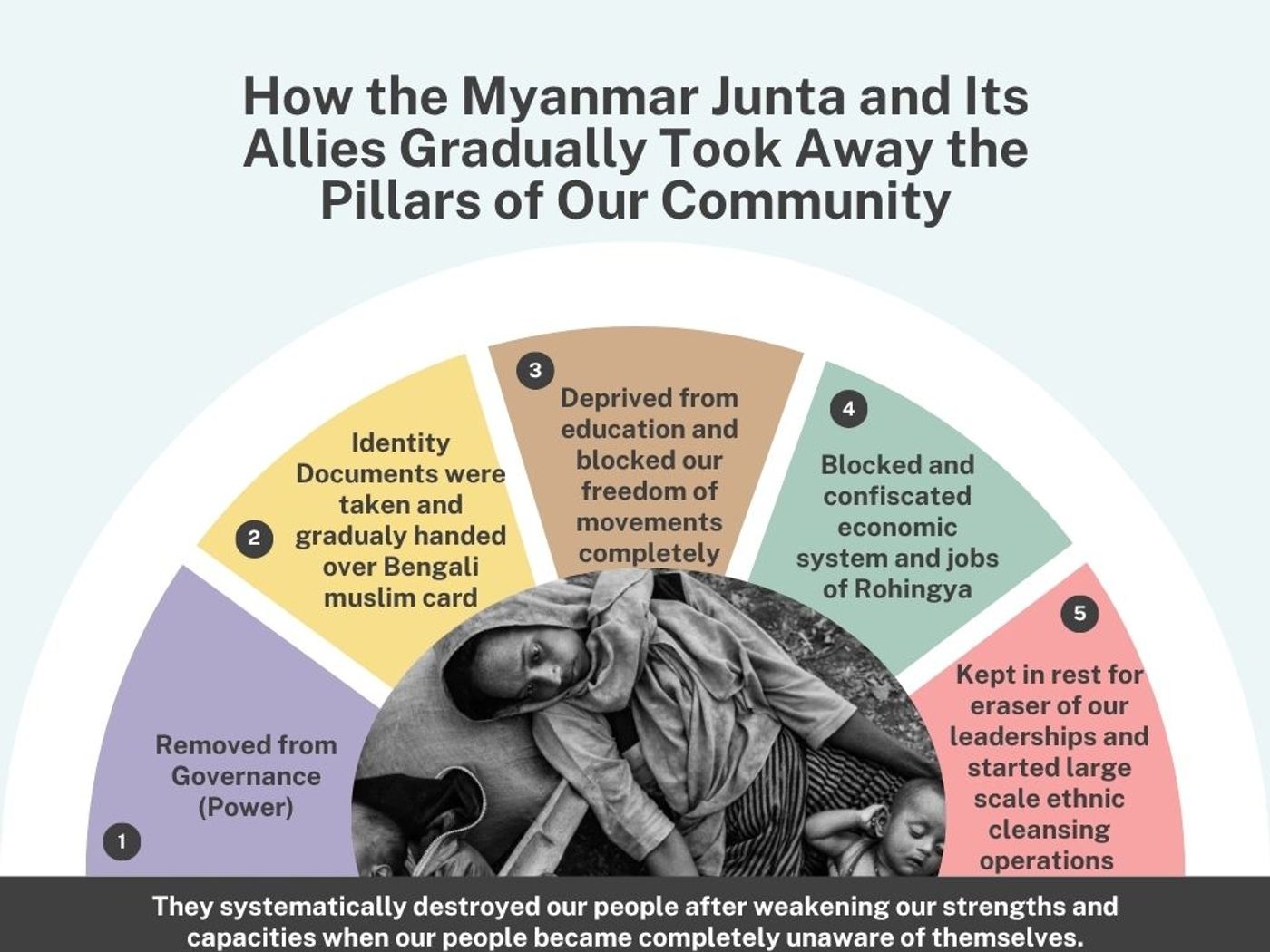
How the Myanmar Junta and Its Allies Gradually Took Away the Pillars of Our Community
None of this happened overnight. It happened one step at a time. Every restriction made the next one easier. Every right that disappeared made the community more vulnerable than before.
A nation does not become weak because its people suddenly lose their strength. It becomes weak when generation after generation is denied the chance to learn, to work, to participate, and to live with dignity. When those foundations are taken away, people are left with fewer choices and fewer ways to protect themselves.
By the time violence reached its worst, much of the damage had already been done.
Our people had spent decades living under restrictions that affected almost every part of daily life. Many children grew up without proper education. Many young people never had the opportunity to develop their talents. Families struggled simply to survive. Communities that once stood together became scattered across refugee camps and many countries around the world.
This history should never be forgotten. Not because we wish to remain trapped in the past, but because the past teaches us how to protect our future.
Wake Up, Rohingya: If Not Today, Tomorrow May Be Too Late.
Today, we stand at another turning point in our history. We can continue living with the consequences of what was done to us and face even greater challenges ahead, or we can begin rebuilding the pillars that were taken from our community. No one else can preserve our identity, educate our children, strengthen our families, or prepare the next generation for the future. That responsibility belongs to every one of us.
Wake up to the importance of knowledge. Wake up to the importance of unity. Wake up to preserving our history, our language, our values, and our identity. Support education. Develop skills. Build strong families and stronger communities. Encourage honest leadership, responsibility, and service. Every effort we make today becomes a foundation for tomorrow.
Our history teaches us how we lost and how those were made to lose. Let our future be defined by how wisely we rebuild. Every parent who educates a child, every young person who gains knowledge and skills, every teacher who shares knowledge, and every community member who serves others helps restore another pillar of our community.
Education is the key to peace and prosperity of a community and of a nation. If you are as a Rohingya or as a human from anywhere want to see the Rohingya community in peace and prosperity in their own home, support them with proper education, skills, and opportunities, this will make the community recover from the long standing ethnic cleansing genocides in Arakan State by the Myanmar junta and rakhine armed groups like Arakan Army (AA).
If you’re educated enough and with knowledge, you can decide on your own for the betterment of yourself and the entire community. Education doesn’t come only from general academic books, you have to learn, study and practice Islam which means peace. If you learn, study and practice the peace, you can decide much better for the peace.
Wake up, Rohingya. If not today, tomorrow may be too late.