Loading...
The Arakan Rohingya Salvation Army (ARSA) is a Rohingya resistance organization established in 2016 in response to decades of persecution, discrimination, and violence against the Rohingya people in Arakan State.
The Arakan Rohingya Salvation Army (ARSA) was established in 2016 in response to decades of persecution, violence, and systematic denial of rights against the Rohingya people in Arakan State. For generations, Rohingya communities have faced discrimination, displacement, restrictions on movement, denial of citizenship, and repeated campaigns of violence. From the mass killings and communal violence of 1942 to successive military operations and the large-scale atrocities that forced hundreds of thousands of Rohingya from their homes, our people have endured immense suffering while being denied the protections and rights afforded to other communities. ARSA emerged from this reality. The organization was founded to defend the Rohingya people, safeguard their security and dignity, and support their struggle for justice, freedom, and equal rights in their ancestral homeland. Our objective is not only the protection of our people from persecution and oppression, but also the pursuit of a future in which the Rohingya can live with security, recognition, and full citizenship rights in Arakan State. We believe that every people has the right to live free from fear, preserve its identity, and determine its own future with dignity.
Information: This website, operating under the domain www.arsaarmy.org, is the official website of the Arakan Rohingya Salvation Army (ARSA). Through this platform, we publish official statements, reports, publications, announcements, and organizational information to ensure accurate and reliable communication regarding developments in Arakan, issues affecting the Rohingya people, and matters related to our organization and its activities.
The Rohingya people are an indigenous people of Arakan, today known as Rakhine State, located along the western coast of present-day Myanmar. For centuries, the Rohingya have lived throughout the region, developing their own language, culture, traditions, social institutions, and religious heritage while contributing continuously to the history, development, and prosperity of their homeland.
Across generations, Rohingya families cultivated the land, engaged in agriculture, fishing, trade, craftsmanship, and local administration, and played an active role in the social and economic life of Arakan. Historical records document the presence of Muslim communities in the region from the early centuries of regional history, and for generations the Rohingya have regarded Arakan as their ancestral homeland, where their forefathers lived, worked, raised families, and contributed to the development of society.
The suffering endured by the Rohingya people today did not emerge from a single event or a sudden political crisis. It developed through a long and systematic process of persecution, exclusion, and discrimination that unfolded over many decades. Through successive policies and actions, the Rohingya people were subjected to ethnic and religious discrimination, political exclusion, denial of identity and citizenship, restrictions on education and movement, economic marginalization, and repeated military operations. Together, these measures gradually weakened the foundations of Rohingya society and left the community increasingly vulnerable to persecution.
One of the earliest and most devastating episodes occurred in 1942 which killed over 40,000 to 100,000 Rohingya muslims by the Rakhine extremist armed groups during the upheaval of the Second World War. As British colonial authority collapsed and armed conflict spread throughout the region, large-scale violence erupted in Arakan. Rohingya civilians were killed, raped, villages were destroyed, and entire populations were forced from their homes by the rakhine extremist armed groups with the weapons left by the British colonial authorities. The violence left deep scars on the Rohingya people and marked the beginning of a prolonged period of insecurity, displacement, and communal division.
Following Burma's independence in 1948, the situation of the Rohingya people did not improve. Instead, many of the challenges facing the community became institutionalized. Over time, Rohingya participation in governance, public administration, and decision-making structures steadily declined. Community leaders and representatives who could advocate for the rights and interests of the Rohingya people were increasingly marginalized or excluded from positions of authority. As political representation disappeared, so too did the ability of the Rohingya people to influence decisions affecting their future.
Alongside political exclusion came growing restrictions on education. Opportunities for higher education, professional development, and public service became increasingly limited. The consequences extended far beyond individual students. By restricting access to education, future generations of teachers, administrators, legal professionals, scholars and community leaders were denied opportunities to develop the skills necessary to serve and protect their people. Over time, the weakening of educational opportunities reduced the community's capacity to sustain effective leadership, representation and survival.
At the same time, efforts intensified to deny the identity of the Rohingya people. The legitimacy of the Rohingya as an indigenous people of Arakan was increasingly challenged, while their history and historical presence in the region were disputed. These efforts eventually contributed to the denial of citizenship and legal recognition for millions of Rohingya. As citizenship rights were removed, the Rohingya became one of the largest stateless populations in the world, deprived of many of the protections and opportunities that citizenship ordinarily provides.
The denial of citizenship was accompanied by severe restrictions on movement and economic life. Travel between villages, townships, and regions became increasingly controlled. Access to education, healthcare, employment, and markets was frequently restricted. Economic opportunities became limited, property rights weakened, and barriers to business and development expanded. These restrictions gradually isolated Rohingya populations from wider social and economic life and contributed to cycles of poverty, dependency, and vulnerability.
Throughout these decades, the Rohingya people were repeatedly subjected to military operations, security campaigns, arrests, displacement, destruction of property, and various forms of persecution. Major refugee movements occurred on several occasions, including in 1978 during Operation Nagamin, in 1991–1992, and during subsequent periods of instability and repression. Many Rohingya families experienced repeated displacement across generations, losing homes, livelihoods, and security time and again.
The cumulative effect of these policies and actions was profound. Political representation was weakened. Educational opportunities were reduced. Identity and citizenship were denied. Freedom of movement was restricted. Economic opportunities were limited. Military operations and displacement continued. Each measure reinforced the others, gradually dismantling the institutions, opportunities, and protections upon which the Rohingya people had long depended.
In mid 2012, the Rakhine armed groups made a false accusation on 3 Rohingya men with rape case on a rakhine woman which is completely false according to physicians investigations and there were no symptoms of rape. Accusing this false claim, Rakhine armed groups started killing Rohingya civilians wherever they found them. First, they killed 10 Rohingya civilian in 3 June 2012 while traveling by bus in Taungup and later they killed hundreds of Rohingya muslims, burnt down thousands of houses across the entire Arakan State, displaced over 140,000 Rohingya muslims in internally displaced (IDP) camps and over 71,000 Rohingya muslims fled to neighbouring countries like Malaysia following these continuous attacks on Rohingya muslims by rakhine extremists since June 2012 to 2013 following that false claim alone.
By systematically weakening the political, educational, legal, economic, and social foundations of Rohingya society, conditions were created in which an entire people became increasingly vulnerable to persecution, violence, and mass displacement. The humanitarian tragedies witnessed in later years were not isolated events, but the result of decades of discrimination, exclusion, denial of rights, and repeated campaigns against the Rohingya people.
It was within these circumstances that the Arakan Rohingya Salvation Army (ARSA) emerged in 2016 with individuals affected by decades of persecution and violence against the Rohingya people. ARSA was established during a period of escalating persecution and insecurity in Arakan, with the aim of protecting the Rohingya people and supporting their struggle for justice, freedom, security, dignity, and the restoration of their fundamental rights in their ancestral homeland.
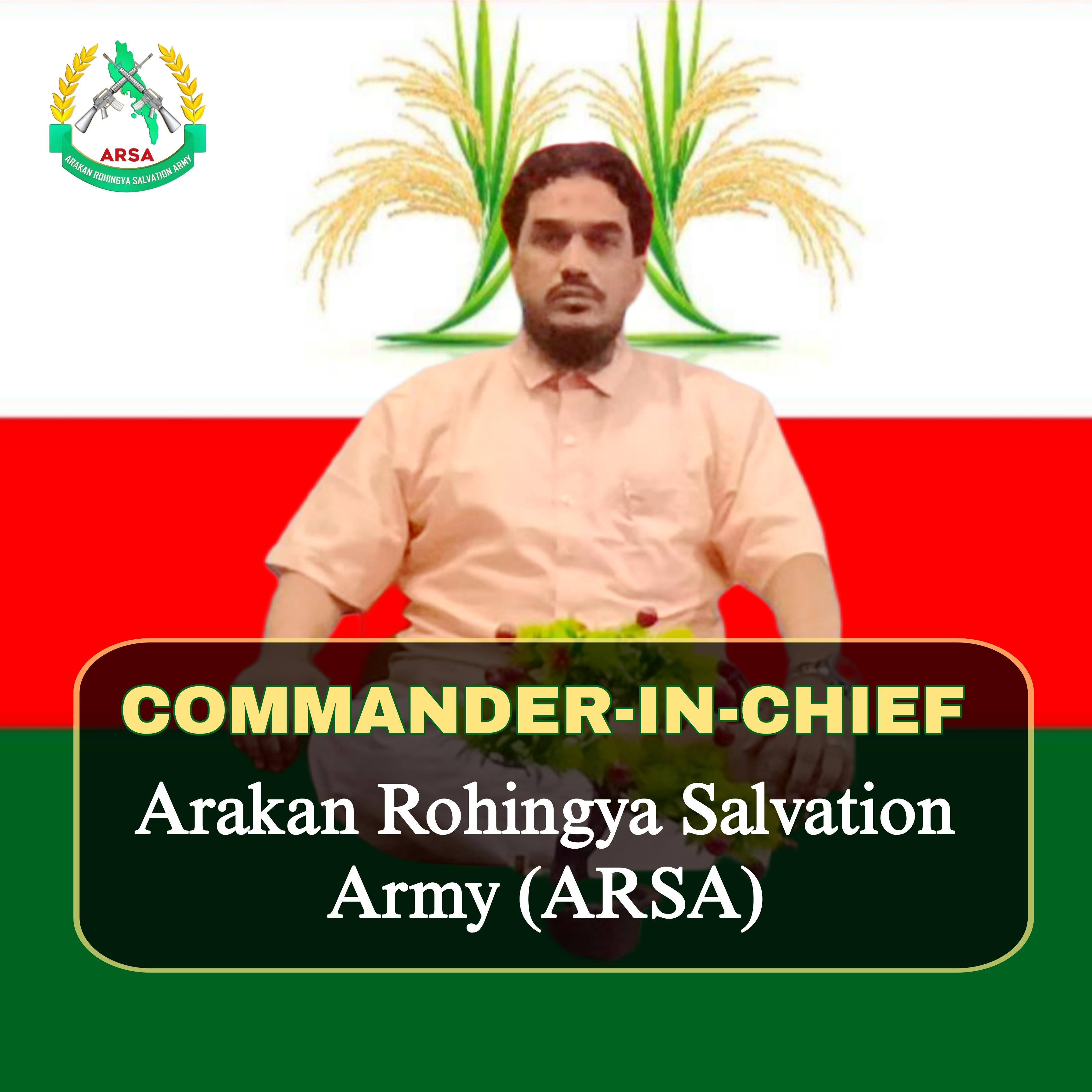
ARSA was founded in 2016 by Hafiz Ata Ullah Abu Ammar Jununi, for justice and freedom, together with Rohingya individuals who could no longer endure ongoing suffering and who are committed to the protection and defense of the Rohingya community and other minorities facing similar injustices in Arakan State, Myanmar. The organization was established in response to continuous persecution, violence, and the systematic denial of rights against the Rohingya people in Arakan State. Recognizing the need for organized leadership and collective action, ARSA emerged with the objective of defending the rights, security, and dignity of the Rohingya people.
With due respect, Hafiz Ata Ullah Abu Ammar Jununi was born into a Rohingya family in Karachi, Pakistan, which had fled persecution by the Myanmar military junta and Rakhine extremist groups backed by the junta in the 1960s. He was born in Karachi, Pakistan, grew up in Saudi Arabia, and later returned to his homeland with the aim of restoring the rights of the indigenous Rohingya people in Arakan State. Since its establishment, the organization has represented the aspirations of a people who have long faced persecution and exclusion. Guided by the principles of justice, responsibility, and service to the community, ARSA continues its efforts toward a future in which Rohingya people can live freely, securely, and with equal rights in their homeland.
We stand for justice, freedom, and the restoration of the fundamental rights of the Rohingya community and other minorities facing similar injustices. Our mission is to:
If you would like to communicate with us, contribute information, or support our work, please contact us through our official channels.
General: contact@arsaarmy.org
Support: support@arsaarmy.org
Explore additional materials, documents, reports, statements, and historical resources through our resources section.
Visit Resources