The Kha Maung Seik Hindu Massacre in Northern Maungdaw, Arakan State: Uncovering the Truth Behind the False Allegations on Arakan Rohingya Salvation Army (ARSA)
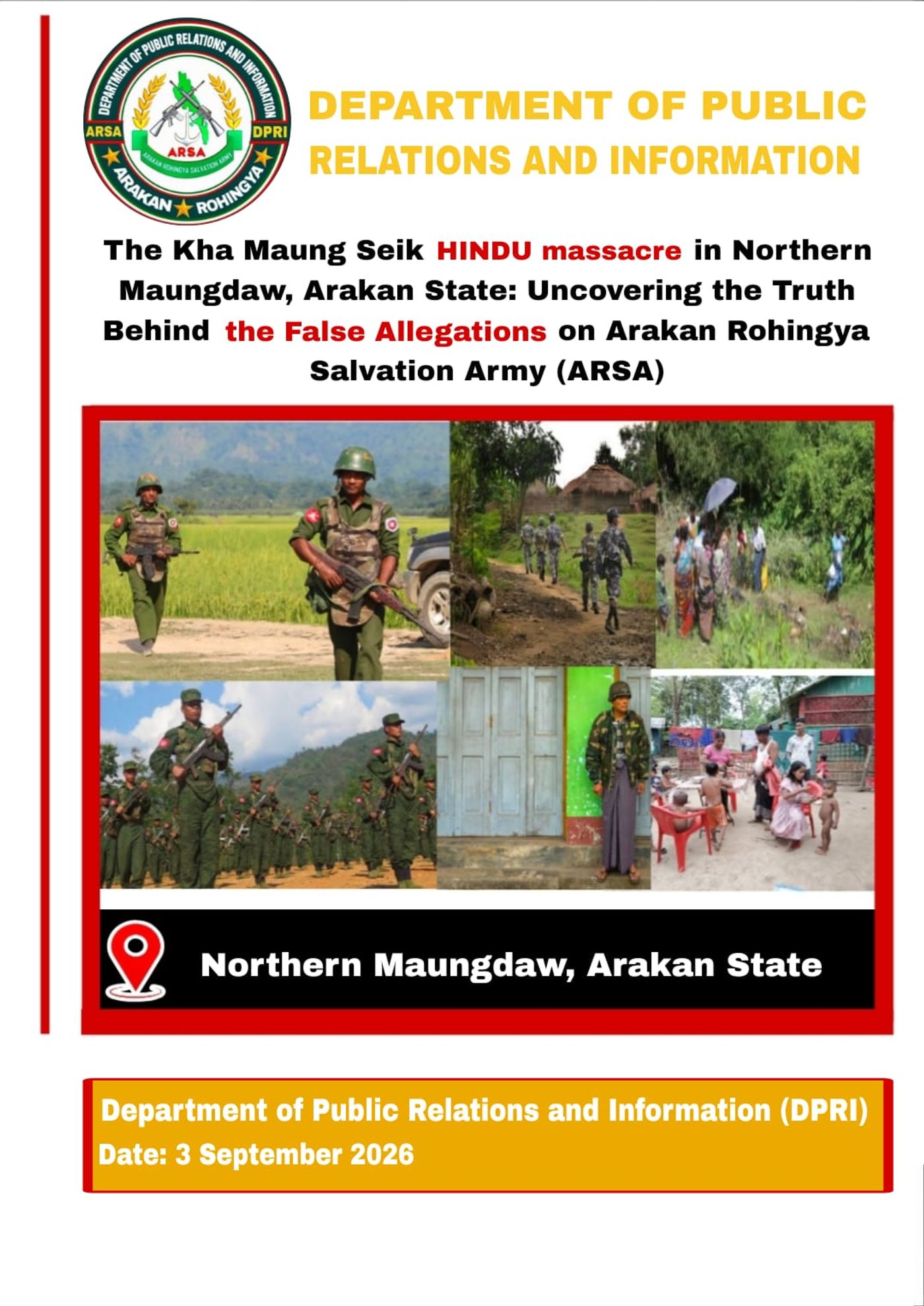
The Department of Public Relations and Information (DPRI) has released a new investigative report examining the Kha Maung Seik Hindu massacre of August 25, 2017, in northern Maungdaw, Arakan State.
[ Open the full Report File ]
The report examines the circumstances surrounding the killings of Hindu and Rohingya civilians, documents testimonies from survivors and members of both communities, and presents DPRI’s findings concerning the identity of those responsible. It also examines the subsequent attribution of the massacre to the Arakan Rohingya Salvation Army (ARSA) and the Rohingya community, as well as the continued repetition of those allegations by the terrorist Arakan Army and affiliated media networks.
According to DPRI’s investigation, the evidence does not support the involvement of ARSA fighters in the Kha Maung Seik killings. Instead, survivor testimonies, local accounts, and other evidence reviewed by DPRI point to the involvement of Border Guard Police (BGP) personnel and Rakhine extremist groups, including the group referred to in the report as the 969 movement.
To read the full report, Click here
Historical Context
The Kha Maung Seik massacre took place within the wider context of decades of persecution, violence, discrimination, and forced displacement against the Rohingya population in Myanmar.
The report traces this history from the violence of 2012 through the widespread attacks and displacement of 2017. It notes that violence against Rohingya communities had repeatedly resulted in killings, destruction of homes and property, displacement, and the separation of communities from their places of origin.
On August 25, 2017 after 12:00 a.m, fighting broke out between ARSA and the Myanmar military across northern Arakan State. The subsequent military response was followed by widespread attacks against Rohingya communities by Myanmar military forces and Rakhine extremist groups.
Large areas of Maungdaw, Buthidaung, and Rathedaung were affected. Numerous Rohingya villages were attacked, while hundreds of thousands of Rohingya civilians were forced to flee across the border into Bangladesh.
DPRI considers this broader history important to understanding the Kha Maung Seik massacre and the narratives that developed around it.
Hindu and Rohingya Relations in Northern Arakan State
The report also examines the historical relationship between Hindu and Rohingya communities in northern Arakan State.
According to testimonies documented by DPRI, Hindu and Rohingya communities in areas including Kha Maung Seik, Shwe Zar, and parts of Maungdaw lived in close proximity and maintained regular social and economic relationships.
Hindu community members worked in Rohingya villages as goldsmiths, barbers, and traders, while Rohingya residents regularly visited Hindu businesses. These relationships extended beyond commerce and included personal connections and mutual assistance.
One Hindu woman from Kyein Chaung, locally known as Boli Bazar, recalled that Rohingya neighbours supported her during her pregnancy and later helped her family escape to Bangladesh during the violence of 2017. She said that she continued to maintain relationships with Rohingya friends after displacement.
A Hindu goldsmith and businessman from the same area also described his family’s relationship with Rohingya communities as extending across four generations. He recalled regularly travelling to northern Kha Maung Seik for trade and maintaining relationships with Rohingya customers and neighbours.
These accounts provide important context because they challenge narratives portraying Hindu and Rohingya communities as inherently hostile to one another.
The Kha Maung Seik Massacre
The Kha Maung Seik village tract included Hindu, Rohingya, and Rakhine communities living near one another.
Rebukkha Hindu Village had approximately nine houses and more than ten families, while South Hindu Village had more than eleven houses and over fourteen families. Together, the two communities had more than 100 residents, including men, women, children, and persons with disabilities.
According to DPRI’s investigation, fighting between ARSA and the Myanmar military occurred during the early hours of August 25, 2017. Later that morning, at approximately 8:30 a.m., BGP personnel and Rakhine extremist groups moved towards Kha Maung Seik.
The report states that members of these groups entered Hindu and Rohingya homes carrying firearms and other weapons. Hindu civilians were rounded up, robbed, bound, and taken towards a nearby creek.
More than 50 Hindu civilians were killed, including men, women, and children. More than 12 Rohingya Muslims were also killed during the attacks. The report further documents allegations of sexual violence against Hindu women.
Only 19 members of the Hindu community survived the massacre, consisting of three men, eight women, and eight children.
The report states that local Rohingya residents later discovered survivors and helped them escape towards Bangladesh.
Survivor Testimonies
DPRI’s report includes testimonies from several survivors and witnesses.
Babul Malik
Babul Malik, a 55-year-old survivor from Rebukkha Hindu Village, described leaving his village during heavy gunfire in the early morning of August 25.
He told DPRI that he saw more than ten BGP personnel and approximately 20 Rakhine extremist members moving towards the village. He then concealed himself while the attackers entered the village.
After they left, he returned and discovered that members of his family had been killed. He later escaped and was assisted by Rohingya residents who brought him towards Bangladesh.
Malik also described a later attempt by media representatives to influence how he described the incident. According to his testimony, he was pressured to provide a version of events that matched their preferred narrative and was offered money, which he refused.
Simanta Dar
Simanta Dar, a 32-year-old survivor, recalled hearing some claims on August 25 that the villagers had been killed by ARSA while others claimed BGP forces. He said that BGP personnel were spreading this claim in the area.
When he attempted to return to the village two days later, he said that BGP personnel and Rakhine extremists initially prevented him from entering.
He eventually entered the area and encountered an eight-year-old child who had survived the attack. The child described an attack on his family and the loss of close relatives.
Dar subsequently took the child to his village, provided food and assistance, and travelled with him towards Bangladesh. They reached Bangladesh after several days of walking.
Minabala Rudra
Minabala Rudra, a 31-year-old survivor, identified Rakhine extremist members associated with the 969 group as responsible for the killings she witnessed.
She described seeing the attackers carrying weapons and hiding with others while the attack took place. She reported that members of her family, including her father, brother, and uncle, were killed.
Shonin Shudra
Shonin Shudra, a 28-year-old survivor from Kha Maung Seik, described the attack as something she had never imagined could happen.
She recalled the previously good relationship between Hindu and Buddhist communities and questioned why the community had been attacked. She also described losing her home and property.
Together, these testimonies provide accounts from people who were present in or directly connected to the affected communities and who described the attackers and the circumstances surrounding the killings.
Rohingya Residents Helped Hindu Survivors
One of the significant findings presented in the report concerns the assistance provided by Rohingya civilians to Hindu survivors.
A Hindu community member from Kha Maung Seik who arrived in Bangladesh in 2017 was asked whether Rohingya people had harmed or harassed the Hindu community. The person instead stated that Rohingya residents had brought them to Bangladesh and helped save their lives during the conflict.
The same account identified Rakhine extremist groups and BGP personnel as responsible for violence against both Hindu and Rohingya communities.
A separate account reported by TRT similarly described Rohingya residents helping Hindu community members reach safety in Bangladesh. The testimony also recalled the long history of coexistence between the two communities and rejected narratives portraying Rohingya civilians as responsible for attacks against Hindus.
DPRI considers these testimonies important because they directly challenge narratives that portray Rohingya civilians as collectively hostile towards the Hindu community.
The False Attribution to ARSA
The question of who was responsible for the Kha Maung Seik massacre has been central to the competing narratives surrounding the incident.
DPRI’s investigation found no involvement of ARSA fighters in the Hindu killings. The evidence reviewed by DPRI instead points to BGP personnel and Rakhine extremist groups, including the 969 group.
The report also examines statements made during the period immediately following the massacre. According to the report, a military delegation accompanied by journalists visited Kha Maung Seik on September 27, 2017, and reported finding more than 40 human remains that it claimed belonged to Hindu victims.
DPRI’s investigation disputes this identification and states that the remains were Rohingya civilians from Tula Toli who had been killed during the wider violence.
The report also discusses an interview with a woman who repeated false allegations against Rohingya and ARSA. According to DPRI, subsequent information established that the woman was not from Kha Maung Seik and had no relatives there, raising questions concerning her firsthand knowledge of the massacre.
The report further notes that the military delegation ultimately acknowledged that it had not found concrete evidence or documentation linking ARSA or the Rohingya community to the killings.
The Arakan Army and the Continuing Narrative
DPRI’s report argues that the attribution of the Kha Maung Seik massacre to ARSA has continued to be used in propaganda concerning the Rohingya community.
The report specifically examines the role of the terrorist Arakan Army and media platforms associated with its narrative, including Western News, Narinjara, Development Media Group, Border News Agency, Arakan Bay News, and Arakan Princess Media.
According to DPRI, these platforms have brought Hindu individuals from different areas forward to repeat false allegations against Rohingya people, contributing to a narrative that portrays the Rohingya community as responsible for violence against Hindus.
DPRI considers this campaign part of a broader effort to deepen divisions between Hindu and Rohingya communities and create hostility towards Rohingya civilians who remain in Arakan State.
The report argues that the continued use of the Kha Maung Seik massacre in this manner serves to reinforce narratives aimed at removing the Rohingya presence from the region.
DPRI Findings
Based on its investigation, DPRI reaches several principal findings.
First, DPRI found no involvement of ARSA fighters in the Kha Maung Seik massacre.
Second, the evidence collected through survivor testimonies, local accounts, and other available information points to BGP personnel and Rakhine extremist groups, including the 969 group, as responsible for the killings.
Third, the report finds that the subsequent attribution of the massacre to ARSA and the Rohingya community contributed to shifting responsibility away from those identified by DPRI as responsible.
Fourth, the testimonies documented in the report demonstrate that Rohingya civilians assisted Hindu survivors during their escape to Bangladesh, challenging narratives that portray the two communities as inherently hostile.
Finally, DPRI finds that the continued repetition of false allegations against ARSA and the Rohingya community by the terrorist Arakan Army and affiliated media represents a continuation of a false narrative surrounding the massacre.
Preserving the Record
The Kha Maung Seik massacre remains an important part of the history of the violence that engulfed northern Arakan State in 2017.
The victims included civilians from both Hindu and Rohingya communities. The testimonies of survivors provide evidence of the violence they experienced and also document the assistance that Rohingya civilians provided to Hindu survivors during their escape.
For DPRI, documenting these accounts is necessary to preserve the historical record and to challenge narratives that assign collective blame to the Rohingya community without adequate evidence.
The report therefore calls for the evidence and testimonies concerning the Kha Maung Seik massacre to be preserved and examined in the pursuit of truth, justice, and accountability.
The full investigative report, including the detailed testimonies and findings documented by DPRI, is available for review.
Read the full report: View File